EVQ-218 research results and test data
EVQ-218 is backed by peer-reviewed characterization, broad-spectrum in vitro antimicrobial testing, serial-passage research across six ESKAPE pathogens, and third-party biocompatibility and application testing. Evidence context: Results reflect the materials, methods, concentrations, and conditions reported in each study. Open a result for those details and its primary source.
Material characterization
Peer-reviewed microscopy and spectroscopy characterize EVQ-218 as a highly spherical silver material with a very narrow size distribution, stable surface behavior, and no detectable oxidative layer in the reported analyses.
Shape
Published STEM and STEM-EELS characterization reports a highly spherical, smooth morphology and a distinct surface structure.
Stability
The characterization record reports stable, nonemissive surface behavior without added capping agents.
Size distribution
EVQ-218 demonstrates a very narrow size distribution in the published characterization record. Exact measurements and analytical methods remain available in the primary paper.
Production
The patented high-energy laser-ablation process engineers structure during formation without chemical or biological synthesis or corrective post-processing. Exceptional batch-to-batch consistency.
A distinct silver metamaterial
EVQ-218 is a distinct silver metamaterial produced through high-energy laser ablation. Its spherical morphology, very narrow size distribution, and stable surface behavior provide the material foundation for the application studies below.
Antimicrobial test data
EVQ-218 has demonstrated in vitro antimicrobial activity across more than 64 bacterial, fungal, and mycobacterial isolates. The records below organize results by organism, resistance status, material format, application method, concentration or loading, exposure, and endpoint.
Antimicrobial results by material application method
| Application method | Sample | Pathogen | Protocol | Innoculation | Log reduction | Chart |
|---|---|---|---|---|---|---|
| Heat or UV-cured coating | UV-cured hydrophilic coated filaments | MRSA | Certika Biofilm and Proliferation Assay | 10^6 | 4+ | |
| Heat or UV-cured coating | Thermal cured hydrophilic coated filaments | Pseudomonas aeruginosa | Certika Biofilm and Proliferation Assay | 10^6 | 4+ | |
| Heat or UV-cured coating | UV-cured hydrophilic coated filaments | Pseudomonas aeruginosa | Certika Biofilm and Proliferation Assay | 10^6 | 4+ | |
| Heat or UV-cured coating | Thermal cured hydrophilic coated filaments | Staphylococcus aureus | Certika Biofilm and Proliferation Assay | 10^6 | 4+ | |
| Heat or UV-cured coating | UV-cured hydrophilic coated filaments | Staphylococcus aureus | Certika Biofilm and Proliferation Assay | 10^6 | 4+ | |
| Pellet treatment | Midline Catheters | Pseudomonas aeruginosa | Certika Biofilm and Proliferation Assay | 10^6 | 4+ | |
| Pellet treatment | Midline Catheters | Staphylococcus aureus | Certika Biofilm and Proliferation Assay | 10^6 | 4+ | |
| Surface infusion | EVQ-218 infused filaments | MRSA | Certika Biofilm and Proliferation Assay | 10^6 | 4+ | |
| Surface infusion | EVQ-218 infused filaments | Pseudomonas aeruginosa | Certika Biofilm and Proliferation Assay | 10^6 | 4+ | |
| Surface infusion | MicroClave – ICU Medical | Pseudomonas aeruginosa | 3BSA – Contact-based surface antimicrobial test | 10^6 | 4+ | |
| Surface infusion | Ureteral Stents | Pseudomonas aeruginosa | Certika Biofilm and Proliferation Assay | 10^6 | 4+ | |
| Surface infusion | EVQ-218 infused filaments | Staphylococcus aureus | Certika Biofilm and Proliferation Assay | 10^6 | 3 | |
| Surface infusion | MaxZero - BD | Staphylococcus aureus | 3BSA – Contact-based surface antimicrobial test | 10^6 | 3.3 | |
| Surface infusion | Ureteral Stents | Staphylococcus aureus | Certika Biofilm and Proliferation Assay | 10^6 | 3 | |
| Surface infusion | Film for platelet/blood bags | Staphylococcus epidermidis | ISO22196 | 10^8 | 4+ | |
| Synthesis phase | TPU film for various devices | Escherichia coli | ISO22196 | 10^4 | 4+ | |
| Synthesis phase | TPU film for various devices | Staphylococcus aureus | ISO22196 | 10^4 | 4+ | |
| Heat or UV-cured coating | UV-cured hydrophilic coated filaments | Escherichia coli | Certika Biofilm and Proliferation Assay | 10^6 | 4+ | |
| Surface infusion | Midline Catheters | Escherichia coli | Certika Biofilm and Proliferation Assay | 10^6 | 4+ | |
| Surface infusion | EVQ-218 infused filaments | Escherichia coli | Certika Biofilm and Proliferation Assay | 10^6 | 4+ |
Species breakdown and MIC ranges
| Pathogen Species | Type | Gram Status | Total Strains | Resistant Strains | Non-Resistant MIC Range (µg/mL) | Resistant MIC Range (µg/mL) | AVG MIC |
|---|---|---|---|---|---|---|---|
| Pseudomonas aeruginosa | Bacteria | Gram negative | 7 | 7 | 0.75-0.75 | 0.25-1 | 0.63 |
| Achromobacter xylosoxidans | Bacteria | Gram negative | 4 | 0 | 0.025-0.75 | N/A | 0.26 |
| Stenotrophomonas maltophilia | Bacteria | Gram negative | 4 | 0 | 0.25-0.5 | N/A | 0.44 |
| Burkholderia cenocepacia | Bacteria | Gram negative | 3 | 0 | 0.125-0.25 | N/A | 0.17 |
| Burkholderia gladioli | Bacteria | Gram negative | 2 | 0 | 0.06-0.125 | N/A | 0.09 |
| Burkholderia multivorans | Bacteria | Gram negative | 2 | 0 | 0.125-0.125 | N/A | 0.13 |
| Haemophilus influenzae | Bacteria | Gram negative | 2 | 0 | 0.25-0.25 | N/A | 0.25 |
| Burkholderia cepacia | Bacteria | Gram negative | 1 | 0 | 0.13 | N/A | 0.125 |
| Burkholderia dolosa | Bacteria | Gram negative | 1 | 0 | 0.25 | N/A | 0.25 |
| Burkholderia vietnamiensis | Bacteria | Gram negative | 1 | 0 | 0.25 | N/A | 0.25 |
| Staphylococcus aureus | Bacteria | Gram positive | 17 | 7 | 1-16 | 2-16 | 5.63 |
| Mycobacterium abscessus/massiliense | Bacteria | Gram positive (Acid-fast) | 9 | 0 | 7.5-10 | N/A | 8 |
| Mycobacterium avium complex | Bacteria | Gram positive (Acid-fast) | 3 | 0 | 2.5-10 | N/A | 5.42 |
| Mycobacterium abscessus subsp. abscessus | Bacteria | Gram positive (Acid-fast) | 1 | 0 | 10.00 | N/A | 10 |
| Mycobacterium smegmatis | Bacteria | Gram positive (Acid-fast) | 1 | 0 | 0.75 | N/A | 0.75 |
| Aspergillus fumigatus | Fungus | N/A | 2 | 0 | 2.5-2.5 | N/A | 2.5 |
| Scedosporium apiospermum | Fungus | N/A | 1 | 0 | 0.50 | N/A | 0.5 |
| Candida albicans | Yeast | N/A | 1 | 0 | 0.13 | N/A | 0.125 |
| Candida parapsilosis | Yeast | N/A | 1 | 0 | 0.13 | N/A | 0.125 |
| Pichia angusta | Yeast | N/A | 1 | 0 | 0.50 | N/A | 0.5 |
Biocompatibility and safety endpoints
ISO 10993-5 MEM elution cytotoxicity
An independent ISO 10993-5 MEM elution study evaluated extracts of EVQ-218-T and EVQ-218-T/IPA using L-929 mouse fibroblasts. All replicates received a reactivity grade of 0, with no evidence of cell lysis or abnormal morphology. The test articles met the ISO 10993-5 acceptance criterion and were non-cytotoxic under the reported extraction and exposure conditions.
| Test/Control Article | Replicate | Reactivity Grade | Description | Overall Result |
|---|---|---|---|---|
| EVQ218-T & EVQ218-T/IPA | 1–3 | 0 | No cell lysis, no morphological changes | Non-cytotoxic |
| Negative control (USP) | 1–3 | 0 | No reactivity | Pass |
| Reagent control | 1–3 | 0 | No reactivity | Pass |
| Positive control | 1–3 | 4 | Nearly complete lysis | Pass (validation) |
Key findings
Reactivity grade 0 across all replicates; no evidence of cell lysis or abnormal cell morphology; response matched the negative and reagent controls; ISO 10993-5 acceptance criterion met.
Inhalation toxicology
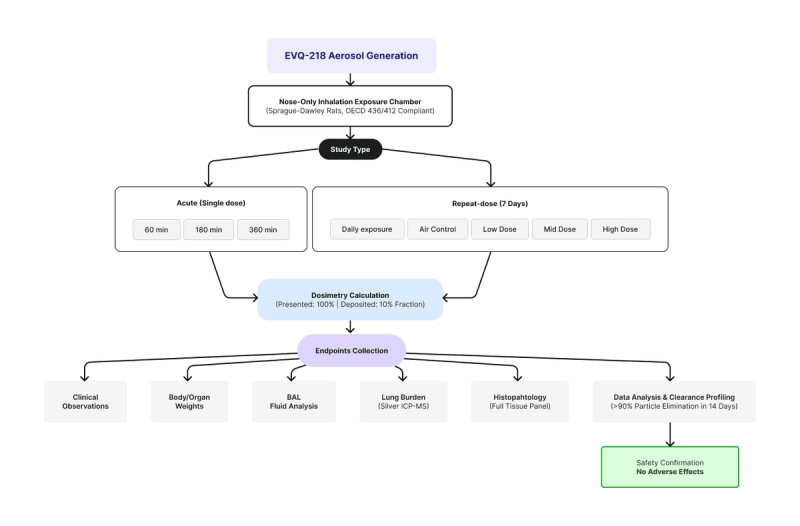
A nose-only inhalation study evaluated aerosolized EVQ-218 in Sprague-Dawley rats under single- and repeated-exposure regimens. No treatment-related clinical signs, body-weight effects, gross pathology, or histopathological changes were observed at the dose levels reported in the study.
| Group | Target Concentration (mg/m³) | Presented Dose (mg/kg/day) | Deposited Dose* (mg/kg/day) | Duration |
|---|---|---|---|---|
| 1 | 0.5 | 0.014 | 0.0014 | Single & 7-day repeat |
| 2 | 2.0 | 0.057 | 0.0057 | Single & 7-day repeat |
| 3 | 5.0 | 0.143 | 0.0143 | Single & 7-day repeat |
Key findings
No treatment-related clinical signs, body-weight effects, gross pathology, or histopathological changes were observed at the dose levels reported in the study.
Study design and methodology
The evidence record retains the study protocol, dose calculations, exposure schedule, laboratory report reference, and the clinical and histopathology endpoints used to evaluate the material.
No measurable MIC increase after 30 serial passages
Serial-passage resistance assessment of EVQ-218
Published serial-passage studies evaluated whether repeated EVQ-218 exposure produced measurable shifts in antimicrobial susceptibility across all six ESKAPE pathogens.
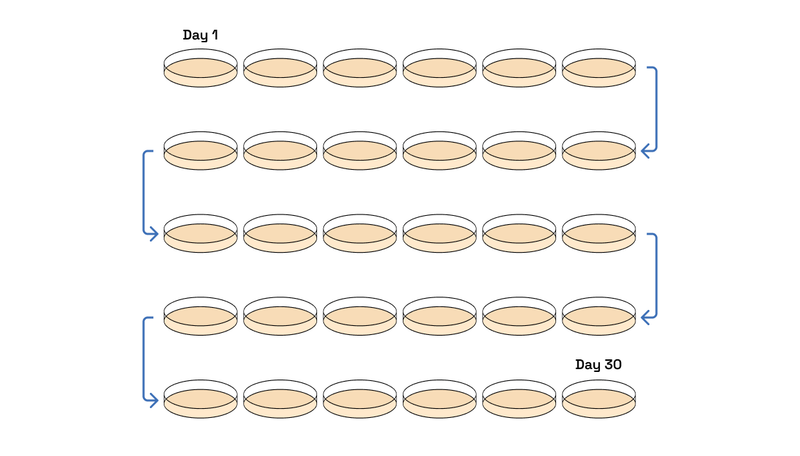
In the 30-passage baseline study, susceptibility remained stable across every organism tested. A second enhanced selective-pressure study likewise reported no measurable MIC increase through 20 passages.
Study design summary
The baseline arm maintained stable sub-MIC exposure through 30 passages. The enhanced arm increased selective pressure at defined intervals through 20 passages. MIC was monitored throughout both study designs.
| Study | Duration | Exposure Strategy | Pathogen Panel | Key Observation |
|---|---|---|---|---|
| Baseline Serial Passage | 30 passages (30 days) | Constant sub-lethal concentration (0.156 µg/mL) | Full ESKAPE panel (ATCC strains) | MICs remained stable across all organisms |
| Enhanced Serial Passage | 20 passages (20 days) | Stepwise concentration escalation (0.5 → 4 µg/mL) | Full ESKAPE panel (ATCC strains) | No adaptive MIC shifts detected |
Pathogens evaluated
Enterococcus faecium, Staphylococcus aureus, Klebsiella pneumoniae, Acinetobacter baumannii, Pseudomonas aeruginosa, and Enterobacter cloacae.
Across all six organisms, no measurable increase in EVQ-218 MIC was detected from the initial passage through the final reported passage.
Selected MIC outcomes
Representative outcomes from the baseline and enhanced study arms show stable EVQ-218 susceptibility across the organisms and passages reported.
| Organism | Initial MIC (µg/mL) | Final MIC (µg/mL) | Interpretation |
|---|---|---|---|
| E. faecium | 5.0 | 12.5 | Susceptibility |
| S. aureus | 5.0 | 2.5 | Increased susceptibility observed |
| K. pneumoniae | 1.25 | 1.25 | Stable susceptibility |
| A. baumannii | 2.5 | 2.5 | Stable susceptibility |
| P. aeruginosa | 0.625 | 0.625 | Stable susceptibility |
| E. cloacae | 2.5 | 2.5 | Susceptibility |
Comparative context
Under comparable serial-passage conditions, tobramycin and ciprofloxacin produced measurable MIC increases in the study organisms. EVQ-218 exposure did not produce a measurable adaptive shift through the final passage of either study arm.
Cross-resistance and interpretation
Isolates that developed resistance to the comparison antibiotics retained susceptibility to EVQ-218 in the reported cross-resistance tests. Together, the findings support resistance-resilient activity and a mechanism distinct from the comparator antibiotics.
Early device-format encrustation testing
EVQ-218 has also been evaluated in an early device-format encrustation study. Treated and untreated samples were submerged in concentrated artificial urine under stationary conditions, monitored over time, and examined using SEM imaging.
The reported comparison used untreated controls and filaments containing EVQ-218. Time-lapse observation tracked visible crystal formation, and SEM imaging examined crystal shape and morphology.
With EVQ-218

The EVQ-218 test format showed reduced crystal formation in the reported comparison, with SEM imaging used to evaluate the resulting surface deposits.
Without EVQ-218

Untreated controls showed larger, less-controlled crystal formation under the same study conditions.
Publications, funding, and independent testing
Antibiotics: peer-reviewed EVQ-218 serial-passage and cross-resistance publication.
ACS Omega: peer-reviewed EVQ-218 physicochemical characterization publication.
Cystic Fibrosis Foundation: support for broad-spectrum in vitro antimicrobial testing.
Seattle Children’s Research Institute: antimicrobial susceptibility testing.
NAMSA: ISO 10993-5 MEM elution cytotoxicity testing.
Lovelace Biomedical: inhalation-toxicology study.
Galbraith Laboratories: ICP-MS analysis supporting exposure and tissue-level measurements.